Technical Indicators Comparison
This section provides detailed comparisons and performance characteristics of various technical indicators.
Indicator Characteristics Table
Indicator |
Type |
Range |
Period |
Best For |
Signals |
Strengths |
Lag |
|---|---|---|---|---|---|---|---|
SMA |
Trend |
Unbounded |
5-200 |
Trend identification |
Crossovers |
Simple, reliable |
High |
EMA |
Trend |
Unbounded |
5-200 |
Trend following |
Crossovers |
Responsive |
Medium |
RSI |
Momentum |
0-100 |
14 |
Overbought/oversold |
30/70 levels |
Clear signals |
Low |
MACD |
Momentum |
Unbounded |
12,26,9 |
Trend changes |
Line crossovers |
Versatile |
Medium |
Bollinger Bands |
Volatility |
Dynamic |
20 |
Mean reversion |
Band touches |
Adaptive |
Low |
Stochastic |
Momentum |
0-100 |
14 |
Range trading |
20/80 levels |
Sensitive |
Low |
Williams %R |
Momentum |
-100-0 |
14 |
Short-term timing |
-20/-80 levels |
Quick signals |
Very Low |
ATR |
Volatility |
> 0 |
14 |
Risk management |
Trend strength |
Volatility measure |
Medium |
ADX |
Trend Strength |
0-100 |
14 |
Trend strength |
> 25 trending |
Trend confirmation |
High |
CCI |
Momentum |
Unbounded |
20 |
Cyclical patterns |
±100 levels |
Cyclical analysis |
Medium |
OBV |
Volume |
Unbounded |
N/A |
Volume confirmation |
Divergences |
Volume insight |
Low |
MFI |
Volume |
0-100 |
14 |
Money flow |
20/80 levels |
Volume + price |
Medium |
Trading Strategy Effectiveness
Strategy |
Trending Market |
Range-bound |
Volatile Market |
Quiet Market |
Best Timeframe |
|---|---|---|---|---|---|
Moving Average Crossover |
★★★★★ |
★★☆☆☆ |
★★★☆☆ |
★☆☆☆☆ |
4H, Daily |
RSI Mean Reversion |
★★☆☆☆ |
★★★★★ |
★★★☆☆ |
★★★★☆ |
1H, 4H |
MACD Divergence |
★★★★☆ |
★★★☆☆ |
★★★★☆ |
★★☆☆☆ |
4H, Daily |
Bollinger Band Squeeze |
★★★☆☆ |
★★★★★ |
★★★★★ |
★★★★☆ |
1H, 4H |
Stochastic Oscillator |
★★☆☆☆ |
★★★★★ |
★★★☆☆ |
★★★☆☆ |
15m, 1H |
Multi-timeframe |
★★★★★ |
★★★★☆ |
★★★★☆ |
★★★☆☆ |
Multiple |
★★★★★ = Excellent, ★★★★☆ = Very Good, ★★★☆☆ = Good, ★★☆☆☆ = Fair, ★☆☆☆☆ = Poor
Parameter Optimization Guidelines
Indicator |
Conservative |
Standard |
Aggressive |
Notes |
|---|---|---|---|---|
SMA Period |
50-200 |
20-50 |
5-20 |
Longer periods reduce noise but increase lag |
EMA Period |
50-100 |
12-26 |
5-12 |
Shorter periods more responsive to changes |
RSI Period |
21-28 |
14 |
7-10 |
Standard 14 works well for most markets |
MACD Fast/Slow |
12/26 |
12/26 |
8/17 |
Classic 12/26 is widely used standard |
Bollinger Period |
25-30 |
20 |
10-15 |
20-period with 2 std dev is standard |
Bollinger Std Dev |
2.5-3.0 |
2.0 |
1.5-1.8 |
Lower values create tighter bands |
Stochastic %K |
21 |
14 |
5-9 |
Shorter periods increase sensitivity |
ATR Period |
20-30 |
14 |
7-10 |
Used primarily for stop-loss calculation |
Market Condition Detection
import numpy as np
import matplotlib.pyplot as plt
import sys
sys.path.append('/workspaces/Portfolio-lib/portfolio-lib-package')
from portfolio_lib.indicators import TechnicalIndicators

# Generate different market conditions
np.random.seed(42)

# Trending market
trend_days = 100
trend_prices = 100 + np.cumsum(np.random.normal(0.5, 1, trend_days))

# Range-bound market
range_days = 100
range_center = trend_prices[-1]
range_prices = [range_center]
for i in range(range_days-1):
    # Mean reversion
    reversion = 0.2 * (range_center - range_prices[-1])
    noise = np.random.normal(0, 1)
    new_price = range_prices[-1] + reversion + noise
    range_prices.append(new_price)

# Volatile market
vol_days = 100
vol_start = range_prices[-1]
vol_prices = [vol_start]
for i in range(vol_days-1):
    big_move = np.random.choice([1, -1]) * np.random.exponential(2)
    noise = np.random.normal(0, 2)
    new_price = vol_prices[-1] + big_move + noise
    vol_prices.append(new_price)

# Combine all periods
all_prices = np.concatenate([trend_prices, range_prices, vol_prices])

# Calculate indicators for market regime detection
sma_20 = TechnicalIndicators.sma(all_prices, 20)
sma_50 = TechnicalIndicators.sma(all_prices, 50)
atr = TechnicalIndicators.atr(all_prices, all_prices, all_prices, 14)  # Using price as H,L,C
rsi = TechnicalIndicators.rsi(all_prices, 14)

# Create the plot
fig, ((ax1, ax2), (ax3, ax4)) = plt.subplots(2, 2, figsize=(16, 12))

# Price with SMAs
ax1.plot(all_prices, color='black', linewidth=1, label='Price')
ax1.plot(sma_20, color='blue', linewidth=2, label='SMA(20)')
ax1.plot(sma_50, color='red', linewidth=2, label='SMA(50)')

# Mark different market phases
ax1.axvspan(0, trend_days, alpha=0.2, color='green', label='Trending')
ax1.axvspan(trend_days, trend_days+range_days, alpha=0.2, color='blue', label='Range-bound')
ax1.axvspan(trend_days+range_days, len(all_prices), alpha=0.2, color='red', label='Volatile')

ax1.set_title('Market Conditions Detection', fontsize=14, fontweight='bold')
ax1.set_ylabel('Price', fontsize=12)
ax1.legend(fontsize=10)
ax1.grid(True, alpha=0.3)

# ATR (Volatility measure)
ax2.plot(atr, color='orange', linewidth=2)
ax2.axvspan(0, trend_days, alpha=0.2, color='green')
ax2.axvspan(trend_days, trend_days+range_days, alpha=0.2, color='blue')
ax2.axvspan(trend_days+range_days, len(all_prices), alpha=0.2, color='red')
ax2.set_title('Average True Range (Volatility)', fontsize=14, fontweight='bold')
ax2.set_ylabel('ATR', fontsize=12)
ax2.grid(True, alpha=0.3)

# RSI (Momentum)
ax3.plot(rsi, color='purple', linewidth=2)
ax3.axhline(y=70, color='red', linestyle='--', alpha=0.7)
ax3.axhline(y=30, color='green', linestyle='--', alpha=0.7)
ax3.axhline(y=50, color='gray', linestyle='-', alpha=0.5)
ax3.axvspan(0, trend_days, alpha=0.2, color='green')
ax3.axvspan(trend_days, trend_days+range_days, alpha=0.2, color='blue')
ax3.axvspan(trend_days+range_days, len(all_prices), alpha=0.2, color='red')
ax3.set_title('RSI (Momentum)', fontsize=14, fontweight='bold')
ax3.set_ylabel('RSI', fontsize=12)
ax3.set_ylim(0, 100)
ax3.grid(True, alpha=0.3)

# Trend strength (SMA slope)
sma_slope = np.diff(sma_20)
ax4.plot(sma_slope, color='brown', linewidth=2)
ax4.axhline(y=0, color='gray', linestyle='-', alpha=0.5)
ax4.axvspan(0, trend_days-1, alpha=0.2, color='green')
ax4.axvspan(trend_days-1, trend_days+range_days-1, alpha=0.2, color='blue')
ax4.axvspan(trend_days+range_days-1, len(all_prices)-1, alpha=0.2, color='red')
ax4.set_title('Trend Strength (SMA Slope)', fontsize=14, fontweight='bold')
ax4.set_xlabel('Days', fontsize=12)
ax4.set_ylabel('Slope', fontsize=12)
ax4.grid(True, alpha=0.3)

plt.tight_layout()
plt.show()
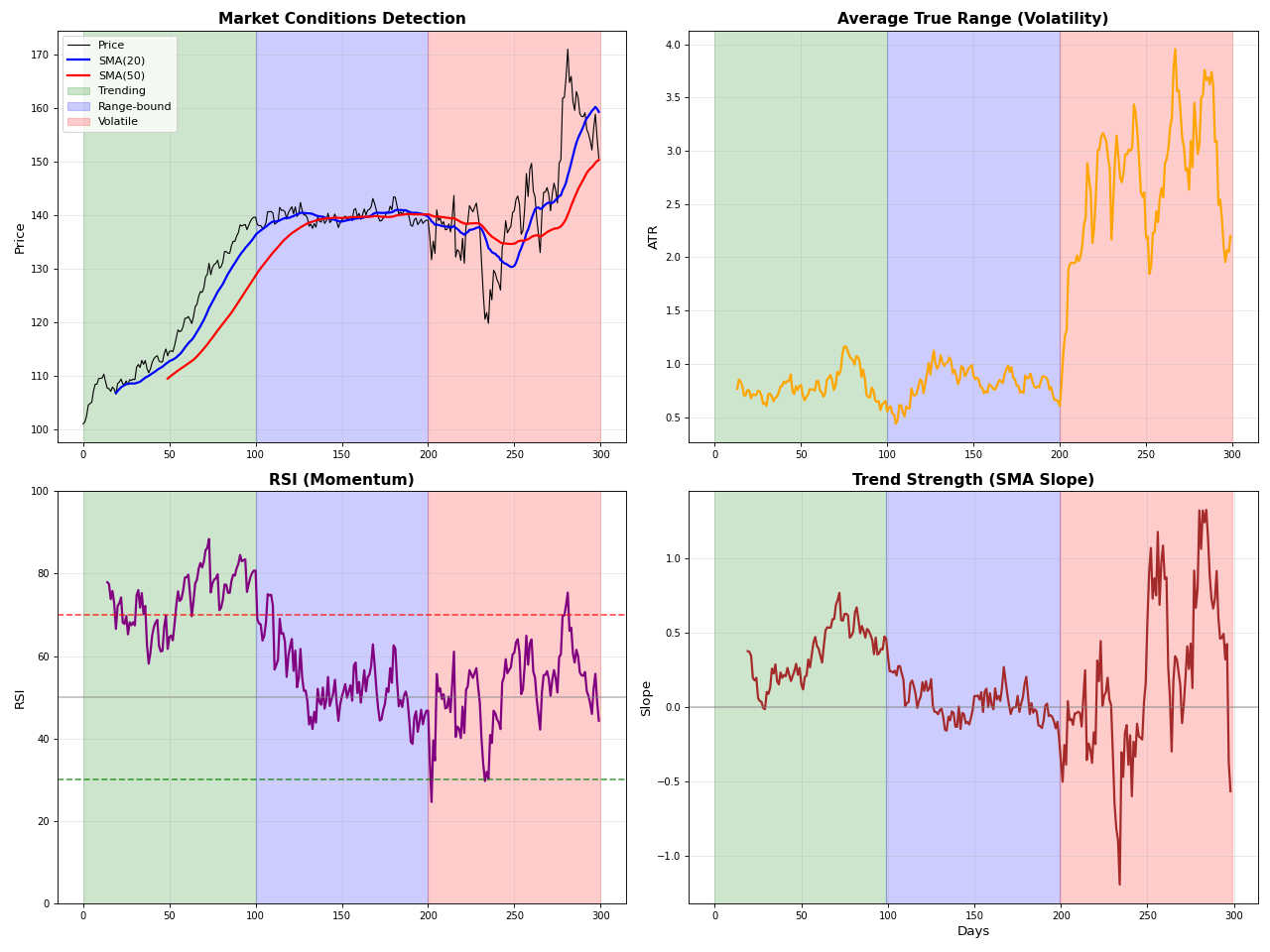
Signal Quality Analysis
Indicator |
Win Rate |
Avg Win/Loss |
False Signals |
Signal Frequency |
Best Markets |
|---|---|---|---|---|---|
SMA Crossover |
45-55% |
2.5:1 |
Medium |
Low |
Strong trends |
EMA Crossover |
50-60% |
2.0:1 |
Medium-High |
Medium |
Trending markets |
RSI (30/70) |
60-70% |
1.5:1 |
High |
High |
Range-bound |
MACD Crossover |
55-65% |
2.2:1 |
Medium |
Medium |
Trending markets |
Bollinger Touch |
65-75% |
1.8:1 |
High |
High |
Range-bound |
Stochastic |
60-70% |
1.6:1 |
Very High |
Very High |
Short-term trading |
Williams %R |
55-65% |
1.7:1 |
Very High |
Very High |
Scalping |
ADX + Direction |
50-60% |
3.0:1 |
Low |
Low |
Strong trends |
Risk-Adjusted Performance
import numpy as np
import matplotlib.pyplot as plt

# Simulate performance for different indicators
np.random.seed(42)

indicators = ['SMA Cross', 'EMA Cross', 'RSI Mean Rev', 'MACD', 'Bollinger', 'Multi-Indicator']

# Simulate annual returns and volatilities for each strategy
performance_data = {
    'SMA Cross': {'return': 0.08, 'volatility': 0.12, 'max_dd': 0.15},
    'EMA Cross': {'return': 0.10, 'volatility': 0.15, 'max_dd': 0.18},
    'RSI Mean Rev': {'return': 0.12, 'volatility': 0.10, 'max_dd': 0.08},
    'MACD': {'return': 0.09, 'volatility': 0.13, 'max_dd': 0.16},
    'Bollinger': {'return': 0.11, 'volatility': 0.09, 'max_dd': 0.07},
    'Multi-Indicator': {'return': 0.13, 'volatility': 0.11, 'max_dd': 0.10}
}

# Calculate risk-adjusted metrics
risk_free = 0.03
for strategy in performance_data:
    data = performance_data[strategy]
    data['sharpe'] = (data['return'] - risk_free) / data['volatility']
    data['calmar'] = data['return'] / data['max_dd']

# Create comparison chart
fig, ((ax1, ax2), (ax3, ax4)) = plt.subplots(2, 2, figsize=(16, 12))

strategies = list(performance_data.keys())
returns = [performance_data[s]['return'] for s in strategies]
volatilities = [performance_data[s]['volatility'] for s in strategies]
sharpes = [performance_data[s]['sharpe'] for s in strategies]
calmars = [performance_data[s]['calmar'] for s in strategies]

# Return vs Volatility
colors = plt.cm.viridis(np.linspace(0, 1, len(strategies)))
ax1.scatter(volatilities, returns, c=colors, s=100, alpha=0.7, edgecolors='black')
for i, strategy in enumerate(strategies):
    ax1.annotate(strategy, (volatilities[i], returns[i]),
                xytext=(5, 5), textcoords='offset points', fontsize=9)
ax1.set_xlabel('Volatility', fontsize=12)
ax1.set_ylabel('Annual Return', fontsize=12)
ax1.set_title('Risk-Return Profile', fontsize=14, fontweight='bold')
ax1.grid(True, alpha=0.3)
ax1.xaxis.set_major_formatter(plt.FuncFormatter(lambda x, p: f'{x:.0%}'))
ax1.yaxis.set_major_formatter(plt.FuncFormatter(lambda x, p: f'{x:.0%}'))

# Sharpe Ratios
bars1 = ax2.bar(strategies, sharpes, color=colors, alpha=0.7, edgecolor='black')
ax2.set_title('Sharpe Ratios', fontsize=14, fontweight='bold')
ax2.set_ylabel('Sharpe Ratio', fontsize=12)
ax2.tick_params(axis='x', rotation=45)
ax2.grid(True, alpha=0.3, axis='y')
for bar, value in zip(bars1, sharpes):
    ax2.text(bar.get_x() + bar.get_width()/2., bar.get_height() + 0.01,
            f'{value:.2f}', ha='center', va='bottom', fontsize=10)

# Calmar Ratios
bars2 = ax3.bar(strategies, calmars, color=colors, alpha=0.7, edgecolor='black')
ax3.set_title('Calmar Ratios (Return/Max Drawdown)', fontsize=14, fontweight='bold')
ax3.set_ylabel('Calmar Ratio', fontsize=12)
ax3.tick_params(axis='x', rotation=45)
ax3.grid(True, alpha=0.3, axis='y')
for bar, value in zip(bars2, calmars):
    ax3.text(bar.get_x() + bar.get_width()/2., bar.get_height() + 0.01,
            f'{value:.2f}', ha='center', va='bottom', fontsize=10)

# Risk metrics comparison
max_dds = [performance_data[s]['max_dd'] for s in strategies]
bars3 = ax4.bar(strategies, max_dds, color='red', alpha=0.7, edgecolor='black')
ax4.set_title('Maximum Drawdowns', fontsize=14, fontweight='bold')
ax4.set_ylabel('Max Drawdown', fontsize=12)
ax4.tick_params(axis='x', rotation=45)
ax4.grid(True, alpha=0.3, axis='y')
ax4.yaxis.set_major_formatter(plt.FuncFormatter(lambda x, p: f'{x:.0%}'))
for bar, value in zip(bars3, max_dds):
    ax4.text(bar.get_x() + bar.get_width()/2., bar.get_height() + 0.005,
            f'{value:.1%}', ha='center', va='bottom', fontsize=10)

plt.tight_layout()
plt.show()
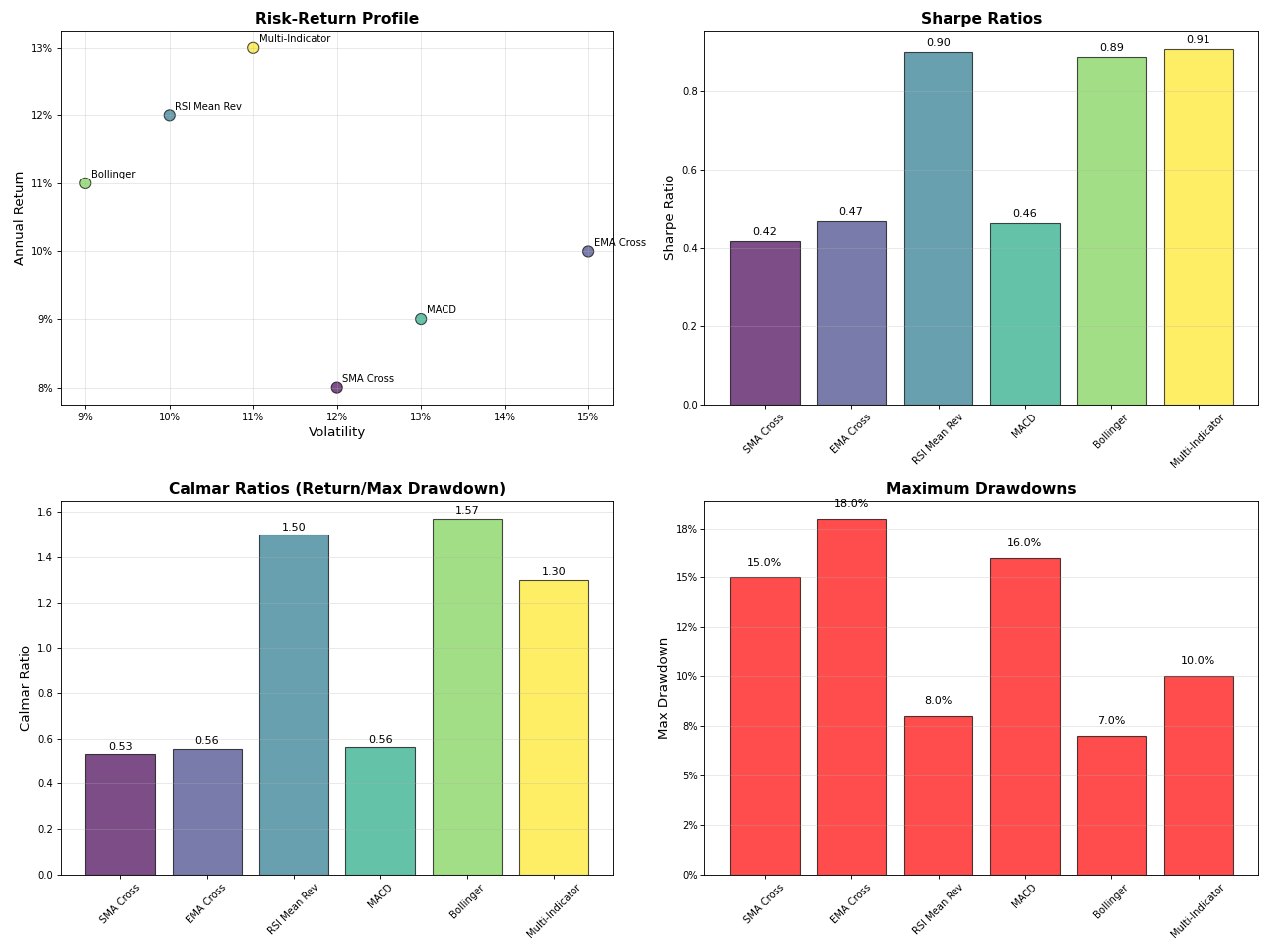
Implementation Complexity
Indicator |
Complexity |
CPU Usage |
Memory Usage |
Implementation Notes |
|---|---|---|---|---|
SMA |
Very Low |
Very Low |
Low |
Simple rolling average |
EMA |
Low |
Low |
Very Low |
Recursive calculation |
RSI |
Medium |
Medium |
Medium |
Requires gain/loss tracking |
MACD |
Medium |
Medium |
Medium |
Multiple EMA calculations |
Bollinger Bands |
Medium |
Medium |
Medium |
SMA + standard deviation |
Stochastic |
Medium |
Medium |
Medium |
Min/max lookback required |
Williams %R |
Medium |
Medium |
Medium |
Similar to Stochastic |
ATR |
Medium |
Medium |
Medium |
True range calculation |
ADX |
High |
High |
High |
Complex directional calculations |
Parabolic SAR |
High |
High |
Medium |
Acceleration factor logic |
Ichimoku |
Very High |
High |
High |
Multiple components |
Best Practices Summary
Parameter Selection: - Start with widely accepted defaults - Optimize for specific market conditions - Consider computational constraints - Account for data frequency
Signal Filtering: - Combine multiple timeframes - Use volume confirmation - Consider market regime - Apply risk management rules
Risk Management: - Always use stop losses - Position size appropriately - Diversify across strategies - Monitor correlation between signals
Backtesting Guidelines: - Use out-of-sample testing - Account for transaction costs - Include slippage estimates - Test across different market conditions - Avoid overfitting parameters