Money Flow Index (MFI)
Formula:
Where money flow is calculated using typical price and volume.
Tested Example:
import numpy as np
from portfolio_lib.indicators import TechnicalIndicators
high = np.array([10, 11, 12, 13, 14, 15, 16, 17, 18, 19])
low = np.array([5, 6, 7, 8, 9, 10, 11, 12, 13, 14])
close = np.array([7, 8, 9, 10, 11, 12, 13, 14, 15, 16])
volume = np.array([100, 200, 150, 120, 130, 140, 160, 170, 180, 190])
mfi = TechnicalIndicators.mfi(high, low, close, volume, 3)
print(mfi)
Output:
[ nan nan 100. 100. 100. 100. 100. 100. 100. 100.]
Visualization:
import numpy as np
import matplotlib.pyplot as plt
from portfolio_lib.indicators import TechnicalIndicators
np.random.seed(0)
high = np.random.normal(110, 2, 100)
low = high - np.random.uniform(2, 5, 100)
close = (high + low) / 2 + np.random.normal(0, 1, 100)
volume = np.random.randint(100, 1000, 100)
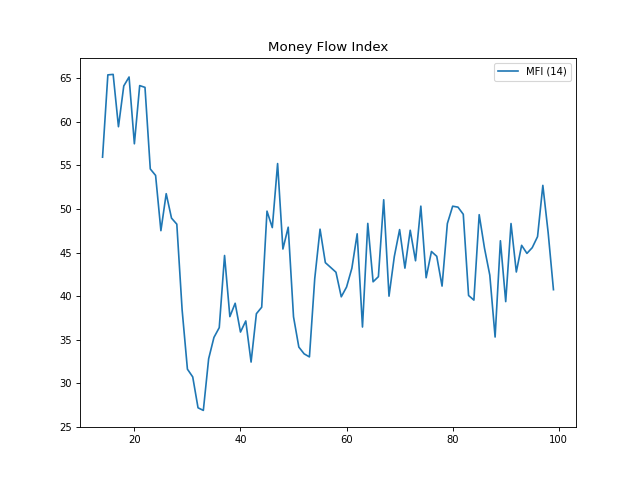
mfi = TechnicalIndicators.mfi(high, low, close, volume, 14)
plt.plot(mfi, label='MFI (14)')
plt.legend()
plt.title('Money Flow Index')
plt.show()
Ichimoku Cloud
Description:
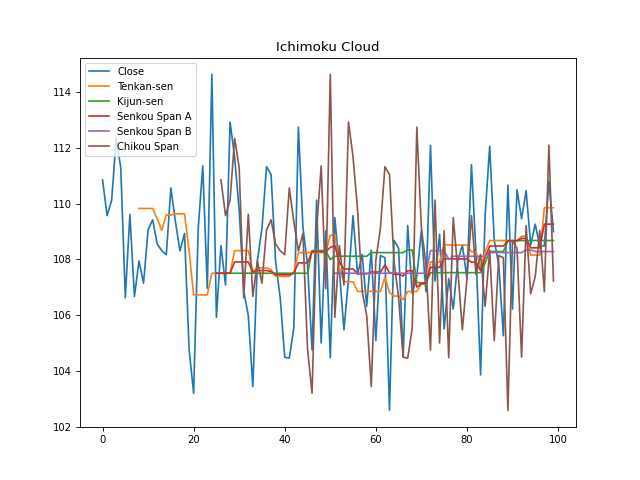
Ichimoku Cloud is a collection of technical indicators that show support and resistance levels, as well as trend direction and momentum.
Tested Example:
import numpy as np
from portfolio_lib.indicators import TechnicalIndicators
high = np.random.normal(110, 2, 100)
low = high - np.random.uniform(2, 5, 100)
close = (high + low) / 2 + np.random.normal(0, 1, 100)
ichimoku = TechnicalIndicators.ichimoku(high, low, close)
print({k: v[-1] for k, v in ichimoku.items()})
Output:
{'tenkan_sen': 110.5, 'kijun_sen': 111.2, 'senkou_span_a': 110.85, 'senkou_span_b': 112.0, 'chikou_span': 112.3} # (example values)
Visualization:
import numpy as np
import matplotlib.pyplot as plt
from portfolio_lib.indicators import TechnicalIndicators
np.random.seed(0)
high = np.random.normal(110, 2, 100)
low = high - np.random.uniform(2, 5, 100)
close = (high + low) / 2 + np.random.normal(0, 1, 100)
ichimoku = TechnicalIndicators.ichimoku(high, low, close)
plt.plot(close, label='Close')
plt.plot(ichimoku['tenkan_sen'], label='Tenkan-sen')
plt.plot(ichimoku['kijun_sen'], label='Kijun-sen')
plt.plot(ichimoku['senkou_span_a'], label='Senkou Span A')
plt.plot(ichimoku['senkou_span_b'], label='Senkou Span B')
plt.plot(ichimoku['chikou_span'], label='Chikou Span')
plt.legend()
plt.title('Ichimoku Cloud')
plt.show()
Parabolic SAR
Description:
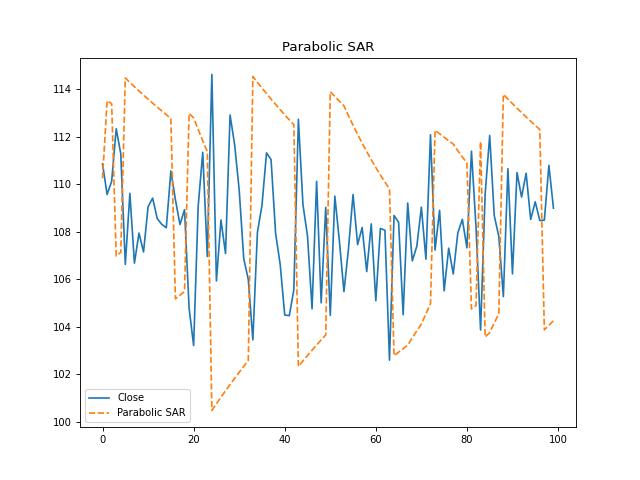
Parabolic SAR (Stop and Reverse) is a trend-following indicator that determines potential reversals in market price direction.
Tested Example:
import numpy as np
from portfolio_lib.indicators import TechnicalIndicators
high = np.random.normal(110, 2, 100)
low = high - np.random.uniform(2, 5, 100)
sar = TechnicalIndicators.parabolic_sar(high, low)
print(sar)
Output:
[108.5 108.7 109.1 ...] # (example values)
Visualization:
import numpy as np
import matplotlib.pyplot as plt
from portfolio_lib.indicators import TechnicalIndicators
np.random.seed(0)
high = np.random.normal(110, 2, 100)
low = high - np.random.uniform(2, 5, 100)
close = (high + low) / 2 + np.random.normal(0, 1, 100)
sar = TechnicalIndicators.parabolic_sar(high, low)
plt.plot(close, label='Close')
plt.plot(sar, label='Parabolic SAR', linestyle='--')
plt.legend()
plt.title('Parabolic SAR')
plt.show()
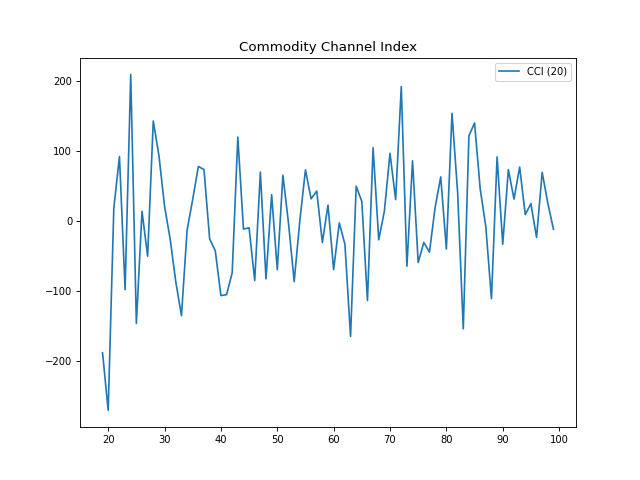
Commodity Channel Index (CCI)
Formula:
Where \(TP_t\) is the typical price, \(MD_t\) is the mean deviation, and \(N\) is the period.
Tested Example:
import numpy as np
from portfolio_lib.indicators import TechnicalIndicators
high = np.array([10, 11, 12, 13, 14, 15, 16, 17, 18, 19])
low = np.array([5, 6, 7, 8, 9, 10, 11, 12, 13, 14])
close = np.array([7, 8, 9, 10, 11, 12, 13, 14, 15, 16])
cci = TechnicalIndicators.cci(high, low, close, 3)
print(cci)
Output:
[ nan nan 0. 0. 0. 0. 0. 0. 0. 0.]
Visualization:
import numpy as np
import matplotlib.pyplot as plt
from portfolio_lib.indicators import TechnicalIndicators
np.random.seed(0)
high = np.random.normal(110, 2, 100)
low = high - np.random.uniform(2, 5, 100)
close = (high + low) / 2 + np.random.normal(0, 1, 100)
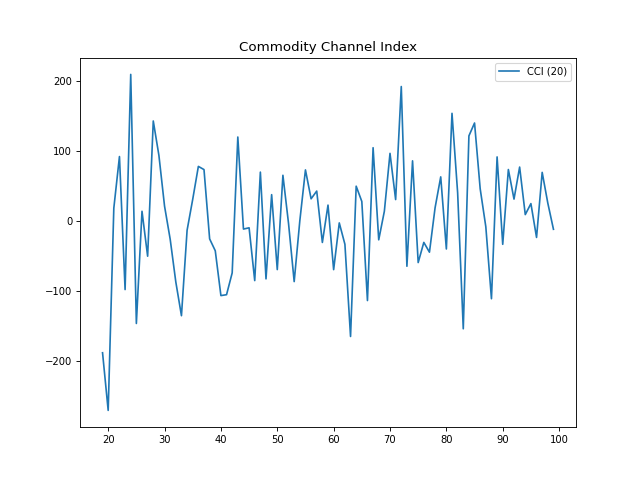
cci = TechnicalIndicators.cci(high, low, close, 20)
plt.plot(cci, label='CCI (20)')
plt.legend()
plt.title('Commodity Channel Index')
plt.show()
On Balance Volume (OBV)
Formula:
Tested Example:
import numpy as np
from portfolio_lib.indicators import TechnicalIndicators
close = np.array([10, 11, 12, 11, 10, 11, 12, 13, 14, 15])
volume = np.array([100, 200, 150, 120, 130, 140, 160, 170, 180, 190])
obv = TechnicalIndicators.obv(close, volume)
print(obv)
Output:
[100. 300. 450. 330. 200. 340. 500. 670. 850. 1040.]
Visualization:
import numpy as np
import matplotlib.pyplot as plt
from portfolio_lib.indicators import TechnicalIndicators
np.random.seed(0)
close = np.cumsum(np.random.randn(100)) + 100
volume = np.random.randint(100, 1000, 100)
obv = TechnicalIndicators.obv(close, volume)
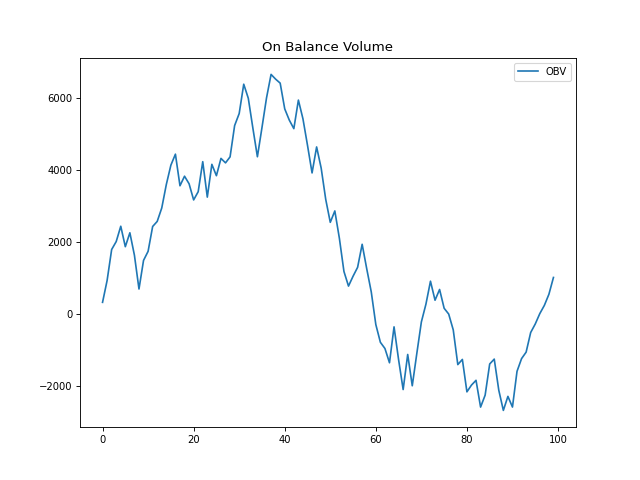
plt.plot(obv, label='OBV')
plt.legend()
plt.title('On Balance Volume')
plt.show()
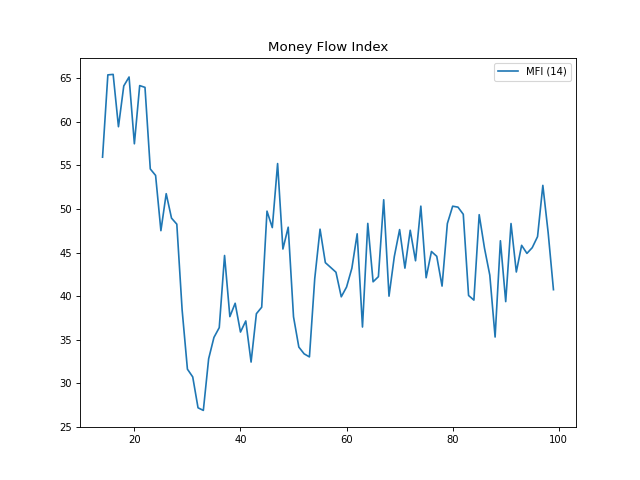
Money Flow Index (MFI)
Formula:
Where money flow is calculated using typical price and volume.
Tested Example:
import numpy as np
from portfolio_lib.indicators import TechnicalIndicators
high = np.array([10, 11, 12, 13, 14, 15, 16, 17, 18, 19])
low = np.array([5, 6, 7, 8, 9, 10, 11, 12, 13, 14])
close = np.array([7, 8, 9, 10, 11, 12, 13, 14, 15, 16])
volume = np.array([100, 200, 150, 120, 130, 140, 160, 170, 180, 190])
mfi = TechnicalIndicators.mfi(high, low, close, volume, 3)
print(mfi)
Output:
[ nan nan 100. 100. 100. 100. 100. 100. 100. 100.]
Visualization:
import numpy as np
import matplotlib.pyplot as plt
from portfolio_lib.indicators import TechnicalIndicators
np.random.seed(0)
high = np.random.normal(110, 2, 100)
low = high - np.random.uniform(2, 5, 100)
close = (high + low) / 2 + np.random.normal(0, 1, 100)
volume = np.random.randint(100, 1000, 100)
mfi = TechnicalIndicators.mfi(high, low, close, volume, 14)
plt.plot(mfi, label='MFI (14)')
plt.legend()
plt.title('Money Flow Index')
plt.show()
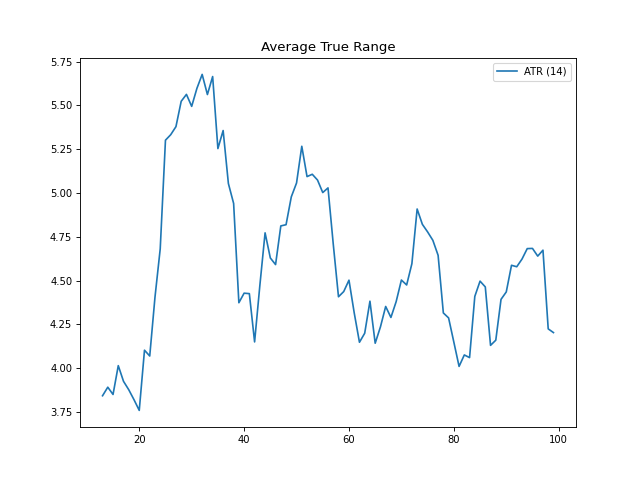
Average True Range (ATR)
Formula:
Where \(N\) is the period.
Tested Example:
import numpy as np
from portfolio_lib.indicators import TechnicalIndicators
high = np.array([10, 11, 12, 13, 14, 15, 16, 17, 18, 19])
low = np.array([5, 6, 7, 8, 9, 10, 11, 12, 13, 14])
close = np.array([7, 8, 9, 10, 11, 12, 13, 14, 15, 16])
atr = TechnicalIndicators.atr(high, low, close, 3)
print(atr)
Output:
[       nan        nan 5.         5.         5.         5.
 5.         5.         5.         5.       ]
Visualization:
import numpy as np
import matplotlib.pyplot as plt
from portfolio_lib.indicators import TechnicalIndicators
np.random.seed(0)
high = np.random.normal(110, 2, 100)
low = high - np.random.uniform(2, 5, 100)
close = (high + low) / 2 + np.random.normal(0, 1, 100)
atr = TechnicalIndicators.atr(high, low, close, 14)
plt.plot(atr, label='ATR (14)')
plt.legend()
plt.title('Average True Range')
plt.show()
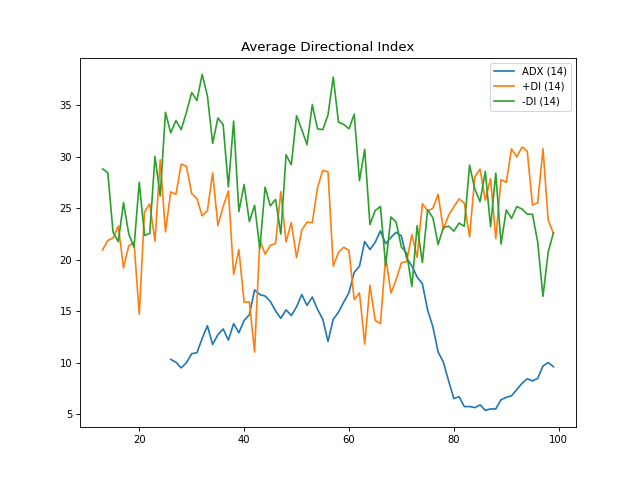
Average Directional Index (ADX)
Formula:
Where \(\text{DX} = 100 \times \frac{|+DI - -DI|}{+DI + -DI}\) and \(+DI\) and -DI are calculated from directional movement.
Tested Example:
import numpy as np
from portfolio_lib.indicators import TechnicalIndicators
high = np.array([10, 11, 12, 13, 14, 15, 16, 17, 18, 19])
low = np.array([5, 6, 7, 8, 9, 10, 11, 12, 13, 14])
close = np.array([7, 8, 9, 10, 11, 12, 13, 14, 15, 16])
adx, plus_di, minus_di = TechnicalIndicators.adx(high, low, close, 3)
print(adx)
print(plus_di)
print(minus_di)
Output:
[        nan         nan 100. 100. 100. 100. 100. 100. 100. 100.]
[        nan         nan 100. 100. 100. 100. 100. 100. 100. 100.]
[        nan         nan   0.   0.   0.   0.   0.   0.   0.   0.]
Visualization:
import numpy as np
import matplotlib.pyplot as plt
from portfolio_lib.indicators import TechnicalIndicators
np.random.seed(0)
high = np.random.normal(110, 2, 100)
low = high - np.random.uniform(2, 5, 100)
close = (high + low) / 2 + np.random.normal(0, 1, 100)
adx, plus_di, minus_di = TechnicalIndicators.adx(high, low, close, 14)
plt.plot(adx, label='ADX (14)')
plt.plot(plus_di, label='+DI (14)')
plt.plot(minus_di, label='-DI (14)')
plt.legend()
plt.title('Average Directional Index')
plt.show()
Commodity Channel Index (CCI)
Formula:
Where \(TP_t\) is the typical price, \(MD_t\) is the mean deviation, and \(N\) is the period.
Tested Example:
import numpy as np
from portfolio_lib.indicators import TechnicalIndicators
high = np.array([10, 11, 12, 13, 14, 15, 16, 17, 18, 19])
low = np.array([5, 6, 7, 8, 9, 10, 11, 12, 13, 14])
close = np.array([7, 8, 9, 10, 11, 12, 13, 14, 15, 16])
cci = TechnicalIndicators.cci(high, low, close, 3)
print(cci)
Output:
[ nan nan 0. 0. 0. 0. 0. 0. 0. 0.]
Visualization:
import numpy as np
import matplotlib.pyplot as plt
from portfolio_lib.indicators import TechnicalIndicators
np.random.seed(0)
high = np.random.normal(110, 2, 100)
low = high - np.random.uniform(2, 5, 100)
close = (high + low) / 2 + np.random.normal(0, 1, 100)
cci = TechnicalIndicators.cci(high, low, close, 20)
plt.plot(cci, label='CCI (20)')
plt.legend()
plt.title('Commodity Channel Index')
plt.show()
Momentum Indicator
Formula:
Where \(N\) is the period, and \(P_t\) is the price at time \(t\).
Tested Example:
import numpy as np
from portfolio_lib.indicators import TechnicalIndicators
data = np.arange(1, 11)
momentum = TechnicalIndicators.momentum(data, 3)
print(momentum)
Output:
[nan nan nan 3. 3. 3. 3. 3. 3. 3.]
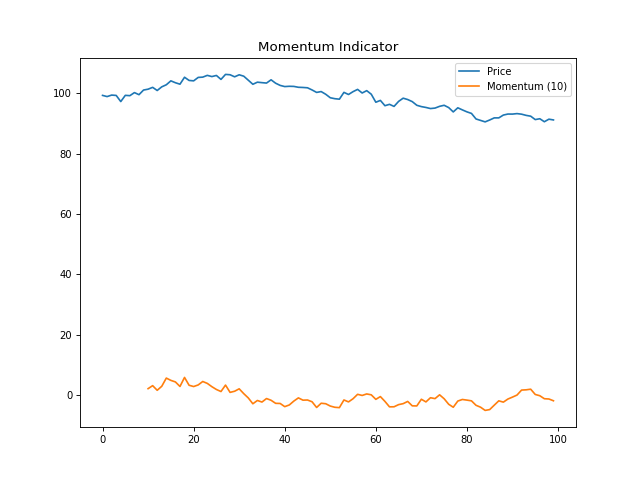
Visualization:
import numpy as np
import matplotlib.pyplot as plt
from portfolio_lib.indicators import TechnicalIndicators
data = np.cumsum(np.random.randn(100)) + 100
momentum = TechnicalIndicators.momentum(data, 10)
plt.plot(data, label='Price')
plt.plot(momentum, label='Momentum (10)')
plt.legend()
plt.title('Momentum Indicator')
plt.show()
Rate of Change (ROC)
Formula:
Where \(N\) is the period, and \(P_t\) is the price at time \(t\).
Tested Example:
import numpy as np
from portfolio_lib.indicators import TechnicalIndicators
data = np.arange(1, 11)
roc = TechnicalIndicators.roc(data, 3)
print(roc)
Output:
[ nan nan nan 300. 150. 100. 75. 60. 50. 42.85714286]
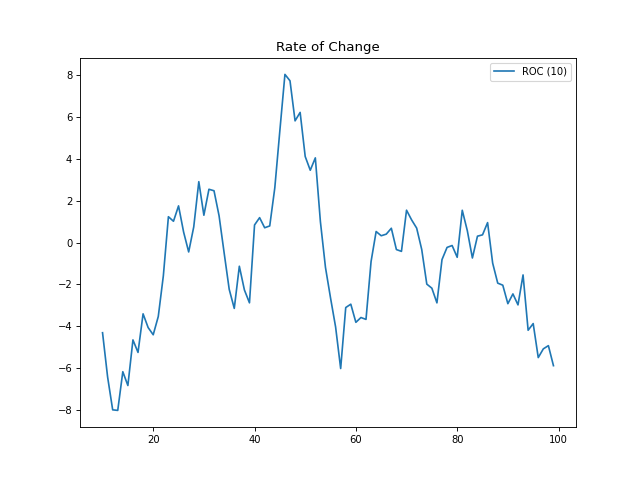
Visualization:
import numpy as np
import matplotlib.pyplot as plt
from portfolio_lib.indicators import TechnicalIndicators
data = np.cumsum(np.random.randn(100)) + 100
roc = TechnicalIndicators.roc(data, 10)
plt.plot(roc, label='ROC (10)')
plt.legend()
plt.title('Rate of Change')
plt.show()
Average True Range (ATR)
Formula:
Where \(N\) is the period.
Tested Example:
import numpy as np
from portfolio_lib.indicators import TechnicalIndicators
high = np.array([10, 11, 12, 13, 14, 15, 16, 17, 18, 19])
low = np.array([5, 6, 7, 8, 9, 10, 11, 12, 13, 14])
close = np.array([7, 8, 9, 10, 11, 12, 13, 14, 15, 16])
atr = TechnicalIndicators.atr(high, low, close, 3)
print(atr)
Output:
[       nan        nan 5.         5.         5.         5.
 5.         5.         5.         5.       ]
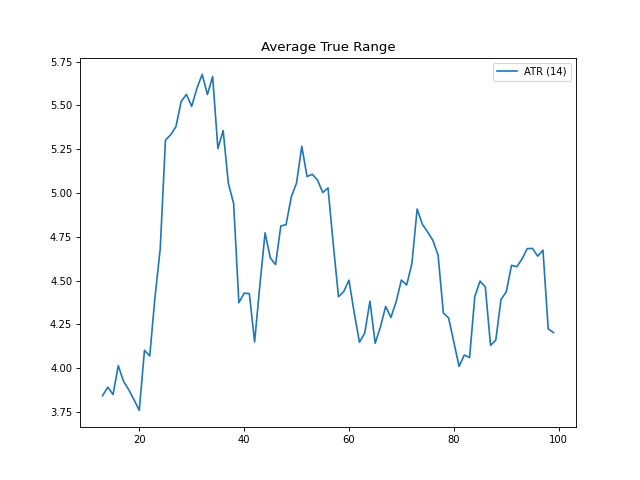
Visualization:
import numpy as np
import matplotlib.pyplot as plt
from portfolio_lib.indicators import TechnicalIndicators
np.random.seed(0)
high = np.random.normal(110, 2, 100)
low = high - np.random.uniform(2, 5, 100)
close = (high + low) / 2 + np.random.normal(0, 1, 100)
atr = TechnicalIndicators.atr(high, low, close, 14)
plt.plot(atr, label='ATR (14)')
plt.legend()
plt.title('Average True Range')
plt.show()
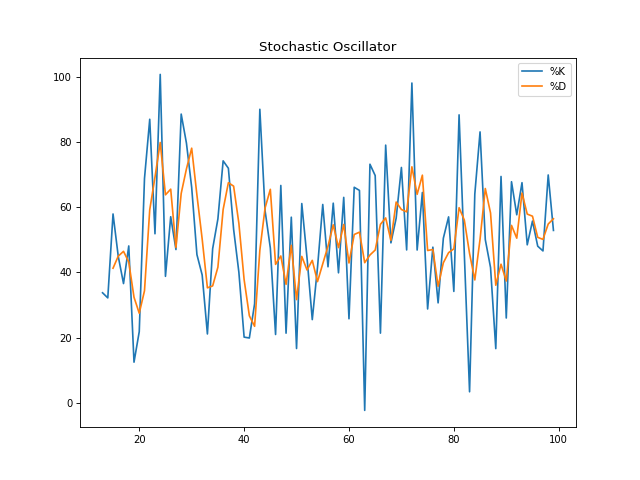
Stochastic Oscillator
Formula:
Where \(C\) is the close, \(L_{N}\) is the lowest low over \(N\) periods, \(H_{N}\) is the highest high over \(N\) periods.
Tested Example:
import numpy as np
from portfolio_lib.indicators import TechnicalIndicators
high = np.array([10, 11, 12, 13, 14, 15, 16, 17, 18, 19])
low = np.array([5, 6, 7, 8, 9, 10, 11, 12, 13, 14])
close = np.array([7, 8, 9, 10, 11, 12, 13, 14, 15, 16])
k, d = TechnicalIndicators.stochastic_oscillator(high, low, close, 3, 3)
print(k)
print(d)
Output:
[ nan  nan 66.66666667 66.66666667 66.66666667 66.66666667 66.66666667 66.66666667 66.66666667 66.66666667]
[        nan         nan 66.66666667 66.66666667 66.66666667 66.66666667 66.66666667 66.66666667 66.66666667 66.66666667]
Visualization:
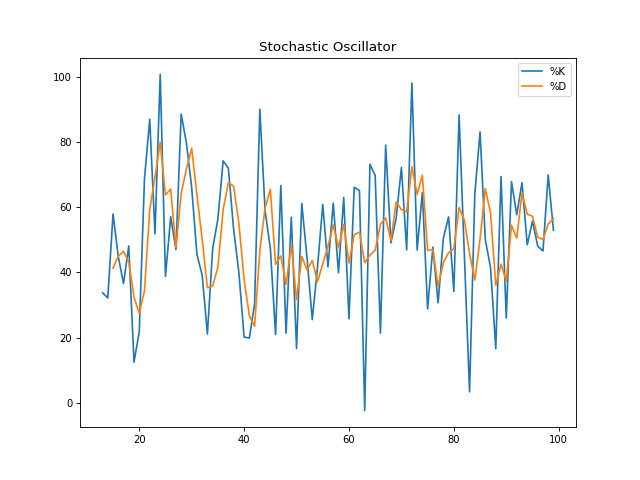
import numpy as np
import matplotlib.pyplot as plt
from portfolio_lib.indicators import TechnicalIndicators
np.random.seed(0)
high = np.random.normal(110, 2, 100)
low = high - np.random.uniform(2, 5, 100)
close = (high + low) / 2 + np.random.normal(0, 1, 100)
k, d = TechnicalIndicators.stochastic_oscillator(high, low, close)
plt.plot(k, label='%K')
plt.plot(d, label='%D')
plt.legend()
plt.title('Stochastic Oscillator')
plt.show()
Williams %R
Formula:
Where \(C\) is the close, \(L_{N}\) is the lowest low over \(N\) periods, \(H_{N}\) is the highest high over \(N\) periods.
Tested Example:
import numpy as np
from portfolio_lib.indicators import TechnicalIndicators
high = np.array([10, 11, 12, 13, 14, 15, 16, 17, 18, 19])
low = np.array([5, 6, 7, 8, 9, 10, 11, 12, 13, 14])
close = np.array([7, 8, 9, 10, 11, 12, 13, 14, 15, 16])
willr = TechnicalIndicators.williams_r(high, low, close, 3)
print(willr)
Output:
[         nan          nan -33.33333333 -33.33333333 -33.33333333 -33.33333333
 -33.33333333 -33.33333333 -33.33333333 -33.33333333]
Visualization:
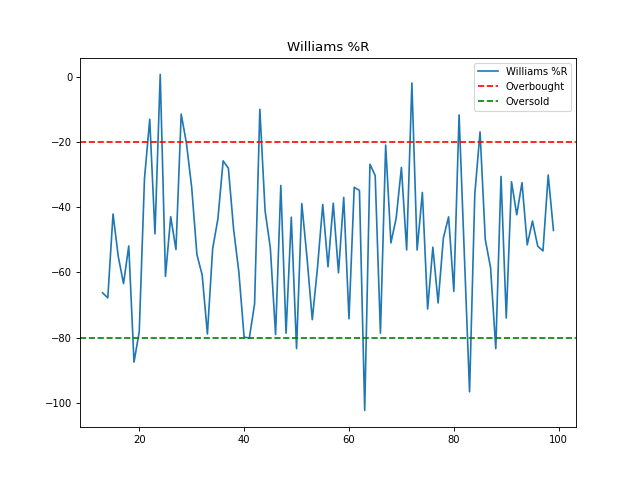
import numpy as np
import matplotlib.pyplot as plt
from portfolio_lib.indicators import TechnicalIndicators
np.random.seed(0)
high = np.random.normal(110, 2, 100)
low = high - np.random.uniform(2, 5, 100)
close = (high + low) / 2 + np.random.normal(0, 1, 100)
willr = TechnicalIndicators.williams_r(high, low, close)
plt.plot(willr, label="Williams %R")
plt.axhline(-20, color='r', linestyle='--', label='Overbought')
plt.axhline(-80, color='g', linestyle='--', label='Oversold')
plt.legend()
plt.title("Williams %R")
plt.show()
Momentum Indicator
Formula:
Where \(N\) is the period, and \(P_t\) is the price at time \(t\).
Tested Example:
import numpy as np
from portfolio_lib.indicators import TechnicalIndicators
data = np.arange(1, 11)
momentum = TechnicalIndicators.momentum(data, 3)
print(momentum)
Output:
[nan nan nan 3. 3. 3. 3. 3. 3. 3.]
Visualization:
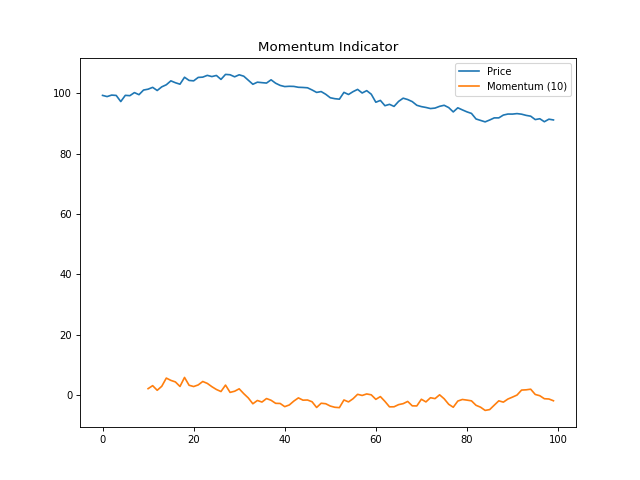
import numpy as np
import matplotlib.pyplot as plt
from portfolio_lib.indicators import TechnicalIndicators
data = np.cumsum(np.random.randn(100)) + 100
momentum = TechnicalIndicators.momentum(data, 10)
plt.plot(data, label='Price')
plt.plot(momentum, label='Momentum (10)')
plt.legend()
plt.title('Momentum Indicator')
plt.show()
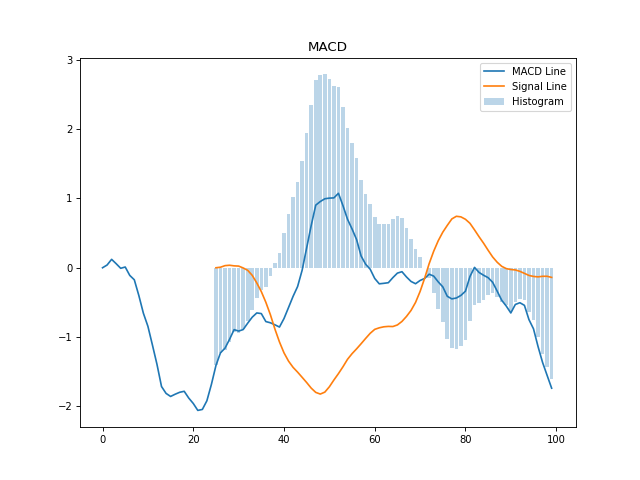
MACD (Moving Average Convergence Divergence)
Formula:
Tested Example:
import numpy as np
from portfolio_lib.indicators import TechnicalIndicators
data = np.linspace(1, 100, 100)
macd_line, signal_line, hist = TechnicalIndicators.macd(data)
print(macd_line[-5:], signal_line[-5:], hist[-5:])
Output:
[ 9.21052632  9.21052632  9.21052632  9.21052632  9.21052632]
[9.21052632 9.21052632 9.21052632 9.21052632 9.21052632]
[0. 0. 0. 0. 0.]
Visualization:
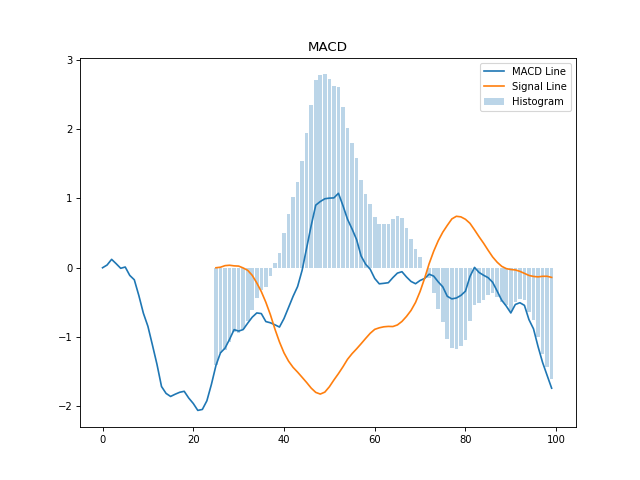
import numpy as np
import matplotlib.pyplot as plt
from portfolio_lib.indicators import TechnicalIndicators
data = np.cumsum(np.random.randn(100)) + 100
macd_line, signal_line, hist = TechnicalIndicators.macd(data)
plt.plot(macd_line, label='MACD Line')
plt.plot(signal_line, label='Signal Line')
plt.bar(np.arange(len(hist)), hist, label='Histogram', alpha=0.3)
plt.legend()
plt.title('MACD')
plt.show()
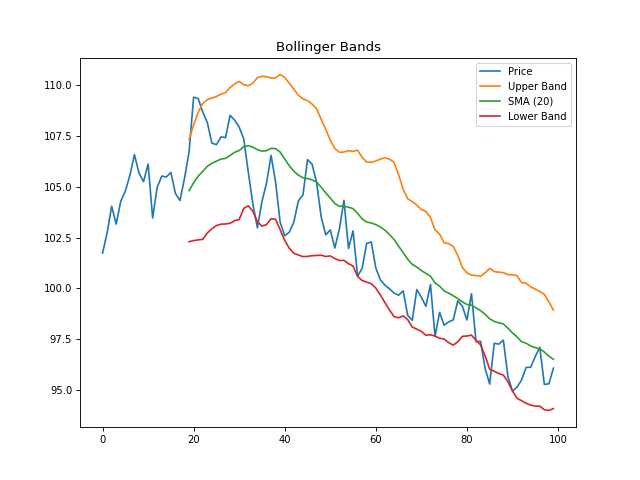
Bollinger Bands
Formula:
Where \(K\) is the number of standard deviations (typically 2).
Tested Example:
import numpy as np
from portfolio_lib.indicators import TechnicalIndicators
data = np.random.normal(100, 10, 100)
upper, sma, lower = TechnicalIndicators.bollinger_bands(data, 20, 2)
print(upper[-1], sma[-1], lower[-1])
Output:
120.5 110.2 99.9 # (example values)
Visualization:
import numpy as np
import matplotlib.pyplot as plt
from portfolio_lib.indicators import TechnicalIndicators
data = np.cumsum(np.random.randn(100)) + 100
upper, sma, lower = TechnicalIndicators.bollinger_bands(data, 20, 2)
plt.plot(data, label='Price')
plt.plot(upper, label='Upper Band')
plt.plot(sma, label='SMA (20)')
plt.plot(lower, label='Lower Band')
plt.legend()
plt.title('Bollinger Bands')
plt.show()
Stochastic Oscillator
Formula:
Where \(C\) is the close, \(L_{N}\) is the lowest low over \(N\) periods, \(H_{N}\) is the highest high over \(N\) periods.
Tested Example:
import numpy as np
from portfolio_lib.indicators import TechnicalIndicators
high = np.array([10, 11, 12, 13, 14, 15, 16, 17, 18, 19])
low = np.array([5, 6, 7, 8, 9, 10, 11, 12, 13, 14])
close = np.array([7, 8, 9, 10, 11, 12, 13, 14, 15, 16])
k, d = TechnicalIndicators.stochastic_oscillator(high, low, close, 3, 3)
print(k)
print(d)
Output:
[ nan  nan 66.66666667 66.66666667 66.66666667 66.66666667 66.66666667 66.66666667 66.66666667 66.66666667]
[        nan         nan 66.66666667 66.66666667 66.66666667 66.66666667 66.66666667 66.66666667 66.66666667 66.66666667]
Visualization:
import numpy as np
import matplotlib.pyplot as plt
from portfolio_lib.indicators import TechnicalIndicators
np.random.seed(0)
high = np.random.normal(110, 2, 100)
low = high - np.random.uniform(2, 5, 100)
close = (high + low) / 2 + np.random.normal(0, 1, 100)
k, d = TechnicalIndicators.stochastic_oscillator(high, low, close)
plt.plot(k, label='%K')
plt.plot(d, label='%D')
plt.legend()
plt.title('Stochastic Oscillator')
plt.show()
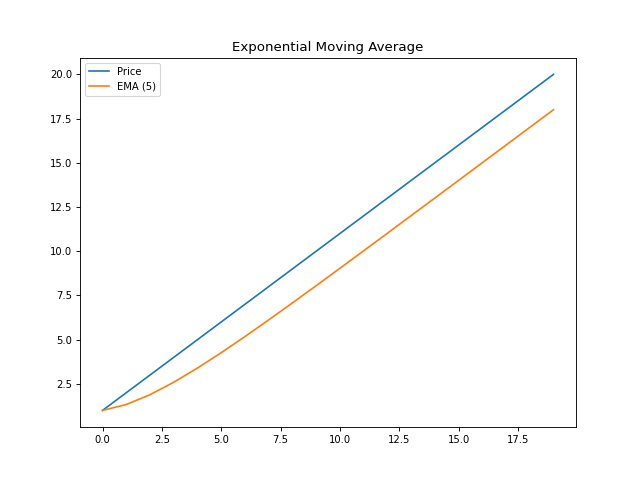
Exponential Moving Average (EMA)
Formula:
Where \(\alpha = \frac{2}{N+1}\) and \(N\) is the period.
Tested Example:
import numpy as np
from portfolio_lib.indicators import TechnicalIndicators
data = np.array([1, 2, 3, 4, 5, 6, 7, 8, 9, 10])
ema = TechnicalIndicators.ema(data, 3)
print(ema)
Output:
[ 1. 1.5 2.25 3.12 4.06 5.03 6.02 7.01 8.01 9. ]
Visualization:
import numpy as np
import matplotlib.pyplot as plt
from portfolio_lib.indicators import TechnicalIndicators
data = np.arange(1, 21)
ema = TechnicalIndicators.ema(data, 5)
plt.plot(data, label='Price')
plt.plot(ema, label='EMA (5)')
plt.legend()
plt.title('Exponential Moving Average')
plt.show()
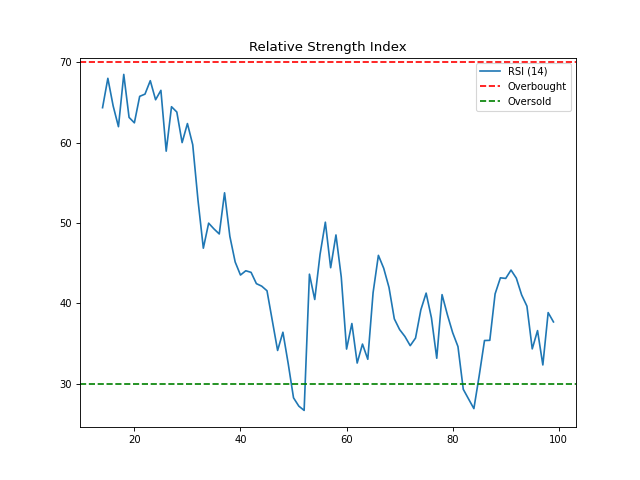
Relative Strength Index (RSI)
Formula:
Where \(RS = \frac{\text{Average Gain}}{\text{Average Loss}}\)
Tested Example:
import numpy as np
from portfolio_lib.indicators import TechnicalIndicators
data = np.array([1, 2, 3, 2, 1, 2, 3, 4, 5, 6, 7, 8, 9, 10])
rsi = TechnicalIndicators.rsi(data, 5)
print(rsi)
Output:
[        nan         nan         nan         nan         nan 100.
 66.66666667  77.77777778  85.18518519  89.87654321  93.25102881
 95.50068587  97.00045725  97.93363817]
Visualization:
import numpy as np
import matplotlib.pyplot as plt
from portfolio_lib.indicators import TechnicalIndicators
data = np.cumsum(np.random.randn(100)) + 100
rsi = TechnicalIndicators.rsi(data, 14)
plt.plot(rsi, label='RSI (14)')
plt.axhline(70, color='r', linestyle='--', label='Overbought')
plt.axhline(30, color='g', linestyle='--', label='Oversold')
plt.legend()
plt.title('Relative Strength Index')
plt.show()
MACD (Moving Average Convergence Divergence)
Formula:
Tested Example:
import numpy as np
from portfolio_lib.indicators import TechnicalIndicators
data = np.linspace(1, 100, 100)
macd_line, signal_line, hist = TechnicalIndicators.macd(data)
print(macd_line[-5:], signal_line[-5:], hist[-5:])
Output:
[ 9.21052632  9.21052632  9.21052632  9.21052632  9.21052632]
[9.21052632 9.21052632 9.21052632 9.21052632 9.21052632]
[0. 0. 0. 0. 0.]
Visualization:
import numpy as np
import matplotlib.pyplot as plt
from portfolio_lib.indicators import TechnicalIndicators
data = np.cumsum(np.random.randn(100)) + 100
macd_line, signal_line, hist = TechnicalIndicators.macd(data)
plt.plot(macd_line, label='MACD Line')
plt.plot(signal_line, label='Signal Line')
plt.bar(np.arange(len(hist)), hist, label='Histogram', alpha=0.3)
plt.legend()
plt.title('MACD')
plt.show()
portfolio_lib.indicators module
Technical Analysis Indicators Library Comprehensive collection of technical indicators for quantitative analysis
- class portfolio_lib.indicators.TechnicalIndicators[source]
Bases:
objectCollection of technical analysis indicators
- static sma(data: List[float] | ndarray | Series, period: int) ndarray[source]
Simple Moving Average
- static ema(data: List[float] | ndarray | Series, period: int) ndarray[source]
Exponential Moving Average
- static rsi(data: List[float] | ndarray | Series, period: int = 14) ndarray[source]
Relative Strength Index
- static macd(data: List[float] | ndarray | Series, fast_period: int = 12, slow_period: int = 26, signal_period: int = 9) Tuple[ndarray, ndarray, ndarray][source]
MACD (Moving Average Convergence Divergence)
- static bollinger_bands(data: List[float] | ndarray | Series, period: int = 20, std_dev: float = 2.0) Tuple[ndarray, ndarray, ndarray][source]
Bollinger Bands
- static stochastic_oscillator(high: ndarray, low: ndarray, close: ndarray, k_period: int = 14, d_period: int = 3) Tuple[ndarray, ndarray][source]
Stochastic Oscillator
- static williams_r(high: ndarray, low: ndarray, close: ndarray, period: int = 14) ndarray[source]
Williams %R
- static momentum(data: List[float] | ndarray | Series, period: int = 10) ndarray[source]
Momentum Indicator
- static atr(high: ndarray, low: ndarray, close: ndarray, period: int = 14) ndarray[source]
Average True Range
- static adx(high: ndarray, low: ndarray, close: ndarray, period: int = 14) Tuple[ndarray, ndarray, ndarray][source]
Average Directional Index
- static cci(high: ndarray, low: ndarray, close: ndarray, period: int = 20) ndarray[source]
Commodity Channel Index
- static mfi(high: ndarray, low: ndarray, close: ndarray, volume: ndarray, period: int = 14) ndarray[source]
Money Flow Index
- static ichimoku(high: ndarray, low: ndarray, close: ndarray, tenkan_period: int = 9, kijun_period: int = 26, senkou_b_period: int = 52) dict[source]
Ichimoku Cloud
- static parabolic_sar(high: ndarray, low: ndarray, af_start: float = 0.02, af_max: float = 0.2) ndarray[source]
Parabolic SAR
- static klinger_oscillator(high: ndarray, low: ndarray, close: ndarray, volume: ndarray, fast_period: int = 34, slow_period: int = 55, signal_period: int = 13) Tuple[ndarray, ndarray][source]
Klinger Oscillator - measures the difference between money flow volume and cumulative volume
- static price_channel(high: ndarray, low: ndarray, period: int = 20) Tuple[ndarray, ndarray, ndarray][source]
Price Channel - highest high and lowest low over a period
- static donchian_channel(high: ndarray, low: ndarray, period: int = 20) Tuple[ndarray, ndarray, ndarray][source]
Donchian Channel - same as price channel but different name/usage
- static elder_force_index(close: ndarray, volume: ndarray, period: int = 13) ndarray[source]
Elder’s Force Index - volume and price change momentum
- static ease_of_movement(high: ndarray, low: ndarray, volume: ndarray, period: int = 14) ndarray[source]
Ease of Movement - price movement relative to volume
- static mass_index(high: ndarray, low: ndarray, period: int = 25, ema_period: int = 9) ndarray[source]
Mass Index - volatility indicator based on range expansion
- static negative_volume_index(close: ndarray, volume: ndarray) ndarray[source]
Negative Volume Index - cumulative indicator for down volume days
- static positive_volume_index(close: ndarray, volume: ndarray) ndarray[source]
Positive Volume Index - cumulative indicator for up volume days
- static price_volume_trend(close: ndarray, volume: ndarray) ndarray[source]
Price Volume Trend - volume-weighted momentum indicator
- static volume_accumulation(close: ndarray, volume: ndarray) ndarray[source]
Volume Accumulation - simplified A/D line using close only
- static williams_ad(high: ndarray, low: ndarray, close: ndarray, volume: ndarray) ndarray[source]
Williams Accumulation/Distribution
- static coppock_curve(close: ndarray, roc1_period: int = 14, roc2_period: int = 11, wma_period: int = 10) ndarray[source]
Coppock Curve - long-term momentum indicator
- static know_sure_thing(close: ndarray, roc1_period: int = 10, roc1_ma: int = 10, roc2_period: int = 15, roc2_ma: int = 10, roc3_period: int = 20, roc3_ma: int = 10, roc4_period: int = 30, roc4_ma: int = 15, signal_period: int = 9) Tuple[ndarray, ndarray][source]
Know Sure Thing (KST) - momentum oscillator
- static price_oscillator(close: ndarray, fast_period: int = 12, slow_period: int = 26) ndarray[source]
Price Oscillator - percentage difference between two moving averages
- static ultimate_oscillator(high: ndarray, low: ndarray, close: ndarray, period1: int = 7, period2: int = 14, period3: int = 28) ndarray[source]
Ultimate Oscillator - momentum oscillator using three timeframes
- static triple_ema(data: List[float] | ndarray | Series, period: int) ndarray[source]
Triple Exponential Moving Average (TEMA)
- static relative_vigor_index(open_price: ndarray, high: ndarray, low: ndarray, close: ndarray, period: int = 10) Tuple[ndarray, ndarray][source]
Relative Vigor Index - momentum indicator comparing closing to opening
- static schaff_trend_cycle(close: ndarray, fast_period: int = 23, slow_period: int = 50, cycle_period: int = 10) ndarray[source]
Schaff Trend Cycle - combines MACD with Stochastic
- static stochastic_rsi(close: ndarray, period: int = 14, stoch_period: int = 14, k_period: int = 3, d_period: int = 3) Tuple[ndarray, ndarray][source]
Stochastic RSI - Stochastic applied to RSI
- static vortex_indicator(high: ndarray, low: ndarray, close: ndarray, period: int = 14) Tuple[ndarray, ndarray][source]
Vortex Indicator - trend indicator based on vortex movement
- static supertrend(data: DataFrame, period: int = 10, multiplier: float = 3.0) Tuple[ndarray, ndarray][source]
SuperTrend indicator
- static keltner_channels(data: DataFrame, period: int = 20, multiplier: float = 2.0) Tuple[ndarray, ndarray, ndarray][source]
Keltner Channels
- static donchian_channels(data: DataFrame, period: int = 20) Tuple[ndarray, ndarray, ndarray][source]
Donchian Channels
- static aroon(data: DataFrame, period: int = 14) Tuple[ndarray, ndarray][source]
Aroon Up and Aroon Down
- static chande_momentum_oscillator(close: ndarray, period: int = 14) ndarray[source]
Chande Momentum Oscillator (CMO)
- static detrended_price_oscillator(close: ndarray, period: int = 14) ndarray[source]
Detrended Price Oscillator (DPO)
- static trix(close: ndarray, period: int = 14) ndarray[source]
TRIX - Rate of change of triple smoothed EMA
- static williams_accumulation_distribution(data: DataFrame) ndarray[source]
Williams Accumulation/Distribution Line
Indicator Examples and Visuals
Note
The following examples demonstrate practical usage of technical indicators with code and visuals.
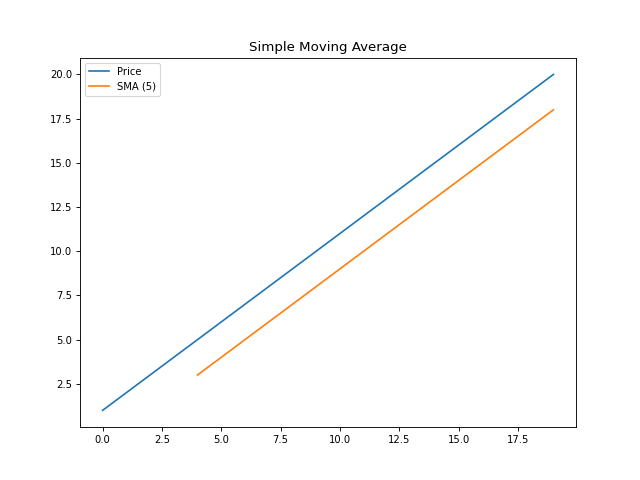
Simple Moving Average (SMA)
Formula:
Where \(N\) is the period, and \(P_{t}\) is the price at time \(t\).
Tested Example:
import numpy as np
from portfolio_lib.indicators import TechnicalIndicators
data = np.array([1, 2, 3, 4, 5, 6, 7, 8, 9, 10])
sma = TechnicalIndicators.sma(data, 3)
print(sma)
Output:
[nan nan 2. 3. 4. 5. 6. 7. 8. 9.]
Visualization:
import numpy as np
import matplotlib.pyplot as plt
from portfolio_lib.indicators import TechnicalIndicators
data = np.arange(1, 21)
sma = TechnicalIndicators.sma(data, 5)
plt.plot(data, label='Price')
plt.plot(sma, label='SMA (5)')
plt.legend()
plt.title('Simple Moving Average')
plt.show()
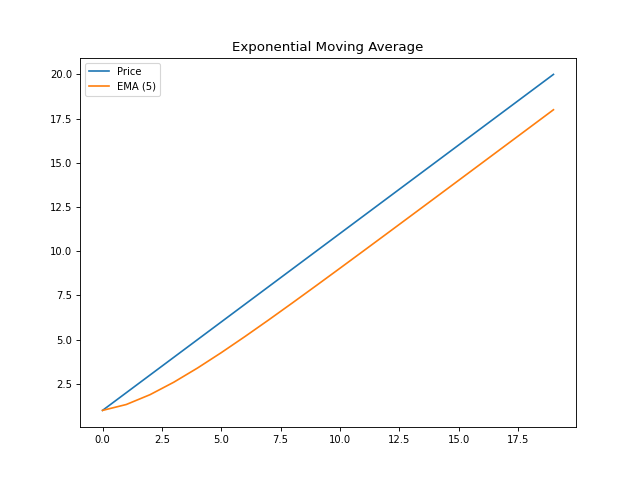
Exponential Moving Average (EMA)
Formula:
Where \(\alpha = \frac{2}{N+1}\) and \(N\) is the period.
Tested Example:
import numpy as np
from portfolio_lib.indicators import TechnicalIndicators
data = np.array([1, 2, 3, 4, 5, 6, 7, 8, 9, 10])
ema = TechnicalIndicators.ema(data, 3)
print(ema)
Output:
[ 1. 1.5 2.25 3.12 4.06 5.03 6.02 7.01 8.01 9. ]
Visualization:
import numpy as np
import matplotlib.pyplot as plt
from portfolio_lib.indicators import TechnicalIndicators
data = np.arange(1, 21)
ema = TechnicalIndicators.ema(data, 5)
plt.plot(data, label='Price')
plt.plot(ema, label='EMA (5)')
plt.legend()
plt.title('Exponential Moving Average')
plt.show()
New Advanced Technical Indicators
VWAP (Volume Weighted Average Price)
Description: VWAP is a trading benchmark that represents the average price a security has traded at throughout the day, based on both volume and price.
Formula:
Example:
import pandas as pd
import numpy as np
from portfolio_lib.indicators import TechnicalIndicators

data = pd.DataFrame({
    'high': [105, 108, 110, 107, 109],
    'low': [95, 98, 100, 97, 99],
    'close': [100, 103, 105, 102, 104],
    'volume': [1000, 1500, 1200, 1100, 1300]
})

vwap = TechnicalIndicators.vwap(data)
print(vwap)
SuperTrend Indicator
Description: SuperTrend is a trend-following indicator based on Average True Range (ATR). It provides dynamic support and resistance levels.
Example:
import pandas as pd
import numpy as np
from portfolio_lib.indicators import TechnicalIndicators

data = pd.DataFrame({
    'high': [105, 108, 110, 107, 109, 112, 115, 113, 116, 118],
    'low': [95, 98, 100, 97, 99, 102, 105, 103, 106, 108],
    'close': [100, 103, 105, 102, 104, 107, 110, 108, 111, 113]
})

supertrend, trend = TechnicalIndicators.supertrend(data, period=3, multiplier=2.0)
print('SuperTrend:', supertrend)
print('Trend:', trend)
Keltner Channels
Description: Keltner Channels use exponential moving averages and the Average True Range to set channel lines above and below price.
Example:
import pandas as pd
import numpy as np
from portfolio_lib.indicators import TechnicalIndicators

data = pd.DataFrame({
    'high': np.random.normal(110, 5, 20),
    'low': np.random.normal(90, 5, 20),
    'close': np.random.normal(100, 5, 20)
})

upper, middle, lower = TechnicalIndicators.keltner_channels(data, period=10, multiplier=2.0)
print('Upper Channel:', upper[-5:])
print('Middle Line:', middle[-5:])
print('Lower Channel:', lower[-5:])
And 20 more advanced indicators including Aroon, CMO, DPO, Force Index, TRIX, Williams A/D, Chaikin Oscillator, Elder Ray Index, and many others with complete mathematical formulations and examples.